
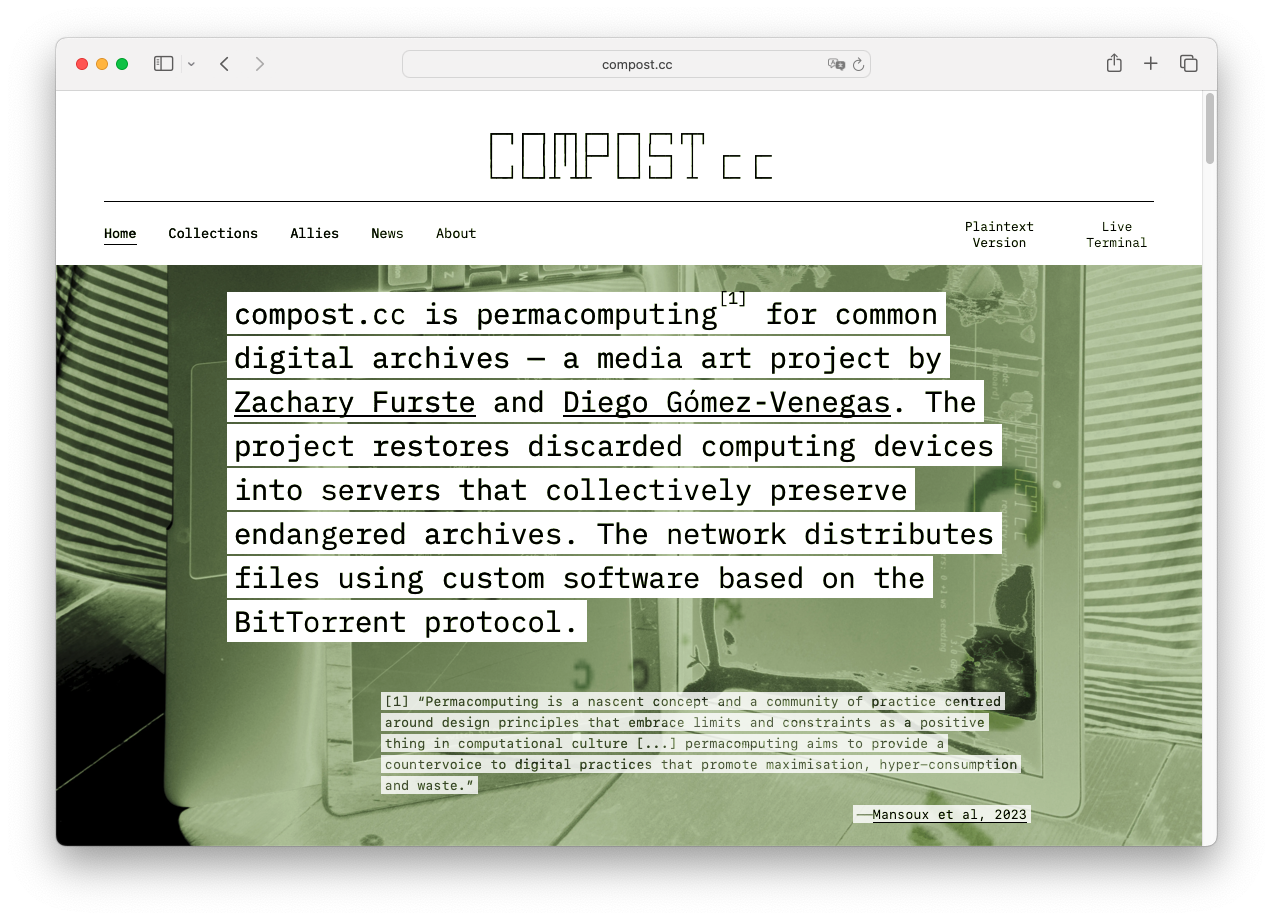
My friend and colleague Zachary Furste and I are working on a permacomputing and digital commons project called compost.cc – in a word, the project restores discarded computing devices into servers that, using the BitTorrent protocol, collectively preserve endangered archives.
Several questions led us to work on this project. First, we asked ourselves about the governance and accessibility of cultural archives. This kind of collection, especially those concerned with the history of technology, remain largely inaccessible to most people either due to institutional policies, lack of funding, or both. This is certainly true for collections concerning the cultural heritage of the Global South, which many times are preserved in and by institutions of the Global North. In this case, the natural heirs of these archives are physically impeded from regaining direct and regular access to these parts of their cultural heritage, and the efforts to amend this problem are still extremely limited and, when they exist, usually conceived and developed through top-down approaches.
A second question refers, of course, to the ownership of these archives. Who or what should own the archives concerning the cultural heritage of collective groups? This is a historically problematic question that, especially when it refers to transplanted archives (that is, for example, those concerning the cultural heritage of the Global South that are preserved by institutions in the Global North), we must not only continue to ask, but also try to solve. In principle, we believe that, when it comes to archives, cultural heritage collections should always be in the public domain, and that contemporary technology allows us to make this not only nominal but effective.
Third, the question of digital and infrastructural sovereignty is also critical for us. In the third decade of the 21st century, it has become abundantly clear that too many aspects of our daily communications are owned by corporations, and, not content with this, that what we add to this process (our voices, gestures, interests, attention, and thinking) are silently and unethically appropriated by these corporations, transformed into data, repacked as outputs, and sold back to us as if it wasn’t the product of our own labor. We believe that this has to be contested, and that one way to do this is to reclaim the ownership of digital information and infrastructure back, and put it in the domain of the commons – that is, in a space that belongs to us all. Of course, this has a lot to do (if not all) with a critique of capitalism. A system that has transformed the question of wealth into a matter of data and information ownership (always in the hands of a very few), and submerges us into a sea of devices, whose ephemeral ownership is controlled by processes of programmed obsolescence and brutal marketing strategies of desire, has to literally be turned upside-down.
It’s for all these reasons, and certainly others, that we have decided to create compost.cc as a permacomputing and digital commons project. On the one hand, we want to revitalize apparently obsolete devices and e-waste, and make new processes, interactions, and collaborations to grow out of this revitalization – that’s why we use the notion of compost. The permacomputing1 logic allows us to put together a network of nodes run by individuals, groups, collectives, and even institutions, that interact as peers driven by the sole goal of collaborating for the common good – in this case, the preservation of our digital common heritage. Accordingly, the first collection the project is helping to preserve and collectivize is the Project Cybersyn Archive – The State of Chile Papers.
The official archive of Project Cybersyn (1971–1973) – a cybernetic system for managing Chile’s national economy, built under Salvador Allende and destroyed by the 1973 military coup – has been preserved at Liverpool John Moores University in England for decades, while small collections have been maintained privately, and sometimes secretly, in different parts of the world – only a couple of these small, private, and inaccessible collections are in Chile. This has to change. Project Cybersyn is a crucial episode of the history of technology in Chile and, I argue, Chileans have the right to access this piece of their history in a more direct way and on a regular basis. For a number of reasons, Project Cybersyn is also a piece of cultural history of high interest for the entire world, and nobody should be forced to have the budget to travel to England to access this material. As a researcher who has devoted over a decade to studying this case, its archive, and related collections, I’m convinced that this material belongs to all Chileans and that everyone in the world should be able to study it – no more secrecy or transplanted archives. However, given that copyright issues can certainly arise, we are making available only the documents that were clearly produced by the State of Chile through one of its agencies, and authored by a State official or employee.2 We hope that bigger efforts and institutional diplomacy can increase the number and scope of the collections that we can include in compost.cc in the near future.3
Finally, we cordially invite you to be part of our project. This means: run a node! Rescue an old computer, tablet, or phone and contact us. Also, we will be organizing workshops to learn together how to reactivate these old machines and make the collection run as part of a digital and infrastructural commons network (news about the workshops are coming soon).
- See “Permacomputing Aesthetics: Potential and Limits of Constraints in Computational Art, Design and Culture,” by Aymeric Mansoux, Brendan Howell, Dušan Barok, and Ville-Matias Heikkilä. ↩︎
- According to Chilean law and most international standards, documents produced by a State agency, when not marked differently (for example, as confidential), are public information, and therefore belong to the public domain – especially after over fifty years. ↩︎
- The archive has many documents signed by Stafford Beer (the British cybernetician and director of Project Cybersyn) and his direct collaborators in England. Beer was hired by the Government of Chile to design and lead this project, and, therefore, I understand that most, if not all, the work he did in this context belongs to the State of Chile. However, none of these documents are included in compost.cc ↩︎